
 Türkçe


What is Pumice (Bims)?
Pumice (also known as "bims") comes from the Italian language and is referred to by various names in different languages. In Turkish, it is known by names such as "süngertaşı," "nasır taşı," "hasır taşı," and "topuktaşı." Pumice (bims) is a volcanic rock type. It has a volcanic glass structure. The most commonly found and used type on Earth is acidic pumice. This type is white and dirty in color. During its formation, rapid cooling and the sudden release of gases result in a highly porous structure. The pores are not interconnected. Its density ranges between 0.5 and 1 gr/cm3. Due to its high porosity, pumice has very low heat and sound permeability.
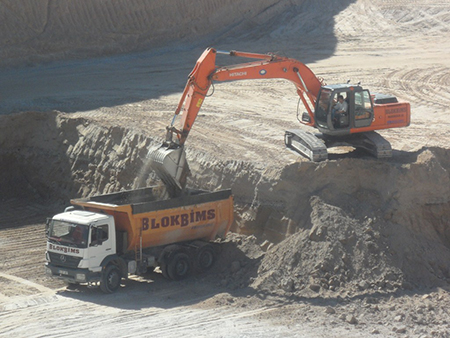
Pumice does not contain crystal water. There are magma pockets formed by the partial melting of basalt deep within the Earth's crust. Under very high pressure, this magma absorbs all substances that would normally be liquid or gas (H2O, CO2, F). Over time, the pressure on these magma pockets decreases due to tectonic movements. When these movements occur, a volcanic eruption begins, and the gases are expelled from the magma.
As the gases are released, the viscosity of the magma increases rapidly, and the solidification temperature rises. As a result, the magma froths, breaks into pieces, and forms the substance known as pumice. This substance is expelled from the crater in a large gas explosion and dispersed into the surrounding environment. The Encyclopaedia Britannica describes pumice as "a highly porous, frozen volcanic glass used as an abrasive in cleaning and polishing, and also utilized as a building material." Pumice (bims) is a rock type that has not had time to crystallize due to rapid cooling. When it solidifies, the steam trapped inside is suddenly released, and the frothing process creates its porous structure. Under these conditions, any kind of lava can turn into pumice.
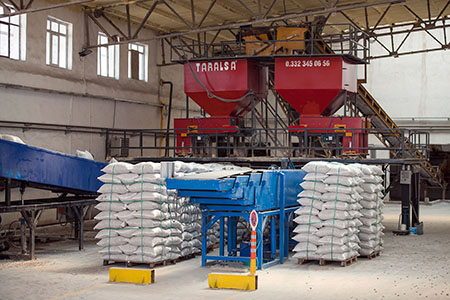
The pumice (bims) we produce is categorized as soft. Our company takes great care in separating volcanic gravel and other foreign materials from the pumice during production. After screening, each group of pumice has uniform dimensions. A washing process is carried out for a clean product, followed by drying. Pumice to be used in the textile industry is screened to a particle size of 1-7 cm and is subjected to tumbling to round off the edges within a sufficient amount of time.
For this industry, white pumice is produced. Our pumice (bims) is packaged in plastic bags. (It can also be shipped in bulk according to orders.) Production is adjusted according to sales, and large quantities are not stocked, which helps prevent problems such as the disintegration of bags during loading, transportation, unloading, and storage at the destination, ensuring the pumice remains intact.
HISTORY of Pumice (bims)
In the 1st century BC, Vitruvius mentioned pumice (bims) in his architectural summaries. Vitruvius describes pumice as lighter than water, thus making it buoyant. He also mentions that it does not absorb water and is hygienic. During the Roman era, pumice (bims) was primarily used in the construction of thermal baths and temples. Some of these structures are still visible today. The most prominent examples from these periods are the Pantheon in Rome and the Hagia Sophia Church in Istanbul. In Germany, pumice began to be used in the 1800s in the city of Rhineland. In Europe, pumice (bims) did not receive much attention. In the United States, the use of pumice (bims) as a building material started in the mid-18th century in California. In the past 30 years, technological advances and increased environmental awareness have significantly expanded the use of pumice (bims).